
Isobel Campbell and Mark Lanegan were a Scottish-American pairing whose music depended on the tension between their very different public and musical identities. Campbell, from Glasgow, first became known through Belle and Sebastian, where her cello, understated vocals and finely detailed songwriting helped define the group’s early sound. Lanegan, born in Ellensburg, Washington, had spent the previous decades as the gravel-voiced frontman of the Screaming Trees and as a collaborator with artists including Queens of the Stone Age. Their partnership was therefore less a conventional band than a meeting between Glasgow’s literate indie-pop tradition and the darker, blues-shaped rock of the Pacific Northwest.
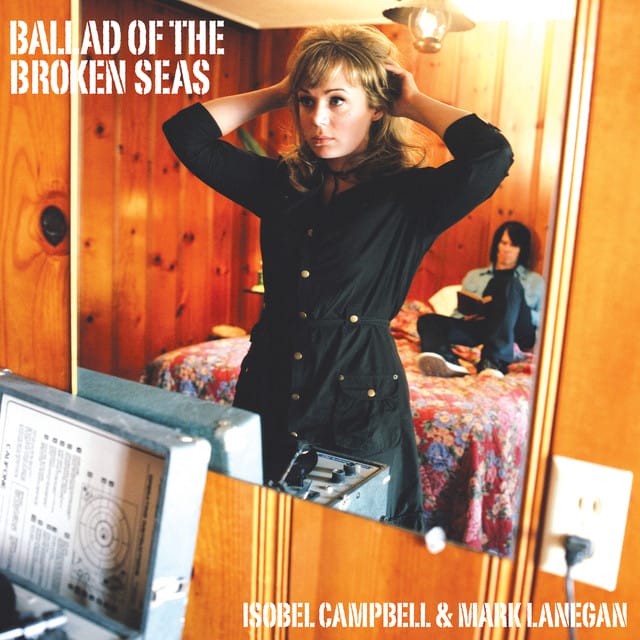
Their first album, Ballad of the Broken Seas (2006), grew out of a collaboration initiated after Campbell contacted Lanegan with the idea of recording together. The contrast was immediately striking: Campbell’s delicate, almost antique vocal phrasing sat against Lanegan’s battered baritone, creating songs that sounded both intimate and faintly haunted. The record’s influences included country duets, traditional folk, torch songs and the stark emotional economy associated with artists such as Lee Hazlewood and Nancy Sinatra. Campbell’s admiration for classic pop and folk songwriting met Lanegan’s affinity for blues, desert rock and the darker side of American roots music.
The album was recorded largely by exchanging parts rather than by the pair working continuously in the same room, a practical arrangement that also suited the music’s sense of distance. That separation became part of the record’s character: Campbell often sounds as if she is addressing Lanegan from another room, while his voice brings the weight of someone answering from a much less forgiving landscape. Their version of “Ramblin’ Man”, originally associated with Hank Williams, made the pairing’s method especially clear, turning a familiar country song into a restrained, melancholy duet rather than a display of vocal power.
Campbell and Lanegan continued the project with Sunday at Devil Dirt (2008) and Hawk (2010). The later records moved away from the first album’s relatively spare balladry, adding fuller arrangements, strings, brass and more pronounced folk-rock and country colours. “Come Undone” and “You Won’t Let Me Down Again” showed how effectively Campbell could use sweetness without making the songs feel cosy, while Lanegan’s performances supplied a bruised counterweight. Their work was influenced less by contemporary indie fashion than by older songwriting forms—murder ballads, country duets, European folk, lounge pop and the dramatic restraint of mid-century records.
There is no well-established story of a major band publicly naming the Campbell–Lanegan project as a direct influence in the way artists often cite Belle and Sebastian or the Screaming Trees. Its significance lies more in the example it set: two musicians from markedly different traditions making the disparity between their voices the central compositional device. Lanegan’s death in 2022 gave the recordings an added poignancy, but their appeal does not depend solely on hindsight. They remain memorable because the songs never try to erase the distance between Campbell’s fragile clarity and Lanegan’s weathered darkness; that distance is precisely where the music lives.