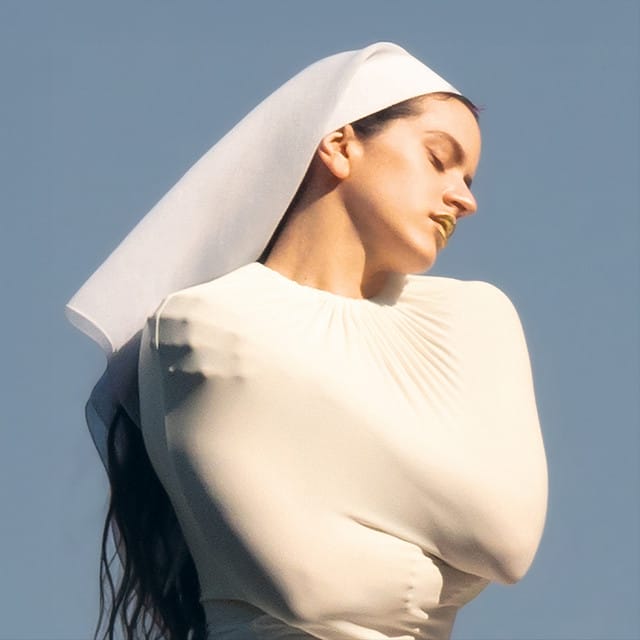
Rosalía Vila Tobella, known simply as Rosalía, is from Sant Esteve Sesrovires, a town near Barcelona in Catalonia, Spain. Her music is rooted in flamenco, but she has never treated the tradition as a sealed-off museum piece. After studying at the Catalonia College of Music, she developed a style that places cante, palmas and densely ornamented vocal lines alongside reggaeton, hip-hop, R&B, electronic production and avant-pop. Her breakthrough album, El Mal Querer (2018), used the structure of a medieval Occitan tale—Flamenca—to frame a modern story about possessiveness, violence and liberation.
Her influences reach well beyond flamenco’s canonical figures. Rosalía has spoken admiringly of Camarón de la Isla, whose radical approach transformed the possibilities of flamenco, as well as traditional singers such as La Niña de los Peines and Carmen Amaya. She has also drawn from contemporary artists including Lauryn Hill, Björk, Kate Bush and Justin Timberlake. That combination helps explain the unusual detail of her work: a vocal melisma can be followed by a stark trap beat, while a pop hook may be arranged with the tension and ceremonial force of a flamenco performance.
A famous anecdote from the making of El Mal Querer concerns Rosalía’s insistence on treating the album as a unified artistic project rather than a collection of unrelated singles. The songs were conceived around chapters, with titles such as “Malamente”, “Pienso en tu mirá” and “Bagdad” carrying the narrative forward. Its visual world was equally deliberate: bullfighting imagery, religious iconography, motorbikes, polished choreography and references to Spanish popular culture were combined into something intentionally provocative. The album’s success turned “Malamente” into an international hit, despite its refusal to flatten flamenco into a conventional pop format.
Her career has also been marked by collaborations that show how widely she operates. She worked with J Balvin and El Guincho on “Con altura”, with James Blake on “Barefoot in the Park”, with Travis Scott on “TKN” and with Billie Eilish on “Lo Vas A Olvidar”. Her third album, Motomami (2022), pushed the contrasts further, moving abruptly between dembow, bachata, industrial textures, piano ballads and fragments of classic song. The record’s title came from a nickname associated with her mother’s motorbike, and its deliberately fragmented sound reflected Rosalía’s interest in speed, reinvention and the unstable nature of contemporary pop.
Rosalía has plainly influenced the direction of Spanish-language pop, especially by making it more acceptable for commercially successful artists to combine regional traditions with aggressively modern production. Her impact is visible in the work of younger singers and producers across Spain and Latin America, although direct, famous claims from established bands naming her as a specific influence are less common than the broader evidence of her influence on the scene. Her importance lies partly in that tension: she is not merely reproducing flamenco, nor abandoning it for international pop, but using its vocal technique, rhythm and emotional severity as active materials in a continually changing sound.