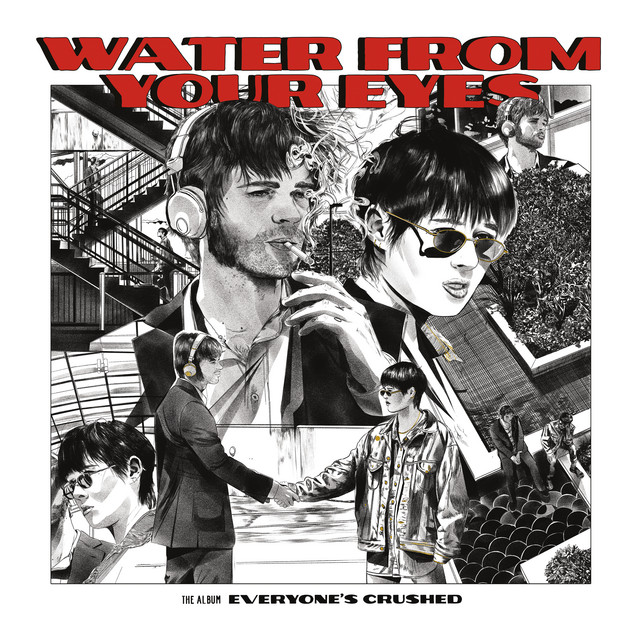

Water from Your Eyes have quietly established themselves as one of the most intriguing and slippery acts to come out of the contemporary indie scene. Formed in Providence, Rhode Island, the duo — Nate Amos and Rachel Brown — first drew attention with a willingness to upend conventional song structures: their early tracks often split phrases between spoken-word cadences and sudden bursts of synthetic melody. That Providence origin still matters to their textures; the city’s small but intensely DIY network and its legacy of experimental music (think the rigour of local college radio and the scrappy inventiveness of nearby noise scenes) gave their sound both an outsider’s edge and a fondness for unexpected sonic detours.
Their influences are less the straight-line lineage of guitar heroism and more a collage of left-field pop and avant-electronic production. You can hear hints of post-punk’s angularity, the slippery hooks of late-2000s indietronica, and the off-kilter melodic logic of acts like Broadcast and Deerhoof. They’ve also spoken in interviews about leaning on the blunt songwriting clarity of classic pop — a counterbalance to their experimental streak — and the DIY aesthetic of Providence contemporaries. That synthesis gives them a peculiar generosity: songs that feel intellectually nimble but built for repeat listening rather than obscure conceptualism.
Anecdotes about the band that actually surface in reporting underline their grassroots credibility. One oft-cited moment was an early house show in Providence where the pair effectively converted a cramped living room into a kinetic communal performance, turning a routine set into an all-night, impromptu collaborative session with other local musicians. Stories like that convey why they’re respected locally: they treat performance as a social act rather than a commercial transaction. More broadly, their 2021 breakthrough LP won notice not because of slick marketing but because playlists and word-of-mouth among tastemakers — notably college stations and influential music blogs — amplified their oddball charms.
As for their impact on other artists, the picture is more modest than the hyperbolic “they changed everything” claims that orbit some indie acts. Still, newer bands in the experimental-pop corridor have cited Water from Your Eyes as a touchstone for how to write hooky, left-field songs without losing warmth. You’ll find their fingerprints on a handful of recent DIY projects that blend abrupt song shifts with intimate lyricism: younger acts have pointed to the duo’s willingness to embrace imperfection — sudden tempo changes, clipped vocal takes — as permission to get messy in pursuit of feeling. That kind of influence is subtle, the sort that reshapes approaches rather than chart positions.
Politically and culturally, their work lands comfortably on the left-leaning side of contemporary indie consciousness. Their lyrics and public statements often reflect a suspicion of commercial gatekeeping and a commitment to community-minded creative practices; they favour small labels, shared bills with mutual-aid fundraisers, and playlists curated by peers over corporate channels. That ethos feeds directly into their music: songs that prize friction and dialogue over pristine production feel like deliberate refusals of the mainstream’s polished neutrality. For listeners tired of both tepid pop and self-important experimentalism, Water from Your Eyes offer a bracing, humane alternative — music that sounds like it was made by people who actually inhabit the same rooms as their audience.